Nov 21, 2026

No. 70 Mac Quyet str, Hung Dao Ward, Hai Phong Cty


Information & products
We try harder, your career better
No. 70 Mac Quyet str, Hung Dao Ward, Hai Phong Cty

ASSESSING MAIN AIR COMPRESSOR OPERATING CONDITION THROUGH PRESSURE AND TEMPERATURE PARAMETERS
Updated: Nov 19, 2026 Views 12
The Main Air Compressor is an essential piece of equipment in a vessel's compressed air system, ensuring a reliable supply of compressed air for main engine starting and other operational requirements. Regular monitoring and evaluation of pressure and temperature parameters play a vital role in identifying early signs of abnormal operation, diagnosing potential faults, and determining appropriate inspection and maintenance measures. In addition, monitoring lubricating oil condition, abnormal noise and vibration, loading and unloading cycles, motor current, and air leakage helps maintain stable and safe operation while improving the overall reliability and efficiency of the vessel's compressed air system.
Basic Assessment of the Main Air Compressor Operating Condition Based on Pressure and Temperature
The basic assessment of the main air compressor's operating condition can be carried out by monitoring and evaluating two important technical parameters: pressure and temperature.
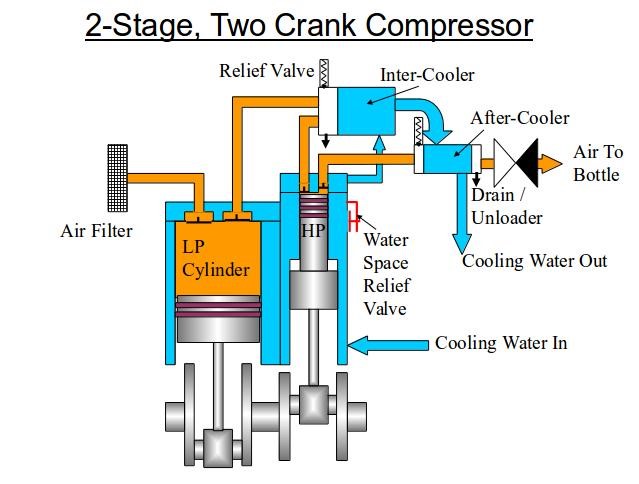 1. Abnormal Pressure – Possible Causes and Diagnosis
|
Abnormal parameter |
Possible causes |
Recommended inspection |
|
First-stage discharge pressure too low |
First-stage suction valve leakage, discharge valve leakage, suction air filter clogged, unload valve leakage, worn piston rings, worn cylinder liner, air tube of inter-cooler leakage |
Inspect suction/discharge valves, air filter, unload valve condition, piston rings and cylinder liner |
|
First-stage discharge pressure too high |
Second-stage suction restriction, intercooler blockage, second-stage valve malfunction |
Check intercooler, connecting pipes and second-stage valves |
|
Second-stage discharge pressure too low |
Second-stage suction valve leakage, discharge valve leakage, worn piston rings Safety valve leakage, air tube of after-cooler leakage |
Inspect second-stage valves, piston rings and cylinder liner |
|
Second-stage discharge pressure too high |
Faulty pressure switch, blocked discharge pipeline, malfunctioning pressure control system |
Check pressure switch, pressure gauge and discharge system |
|
Pressure fluctuates abnormally |
Valve leakage, sticking valves, unstable unloading system, air leakage, safety valve malfunction |
Inspect valves and automatic control system |
|
Compressor takes too long to build up pressure |
Internal leakage, worn piston rings, dirty air filter, excessive air consumption |
Check compressor capacity, valves, filters and air consumption |
|
Air receiver pressure drops quickly |
Air leakage in the distribution system, faulty non-return valve, excessive air consumption |
Check pipelines, receiver valves and air consumers |
2. Abnormal Temperature – Possible Causes and Diagnosis
Temperature is one of the most important indicators of compressor condition.
|
Abnormal parameter |
Possible causes |
Recommended inspection |
|
First-stage discharge temperature too high |
Dirty suction filter, leaking valves, poor cooling, excessive compression ratio |
Check air filter, valves and cooling system |
|
Second-stage discharge temperature too high |
Intercooler inefficient, second-stage valve leakage, poor cooling, excessive compression ratio |
Inspect intercooler, second-stage valves and cooling water flow |
|
Intercooler outlet temperature too high |
Dirty intercooler tubes, insufficient cooling water, cooling water pump malfunction |
Check cooling water flow and clean heat exchanger if necessary |
|
Aftercooler outlet temperature too high |
Aftercooler fouling, insufficient cooling water, blocked cooling passages |
Inspect aftercooler and cooling water system |
|
Cylinder temperature too high |
Poor lubrication, excessive friction, valve leakage, abnormal compression |
Check lubrication, valves and cylinder condition |
|
Bearing temperature too high |
Insufficient lubrication, excessive bearing clearance, bearing wear, misalignment |
Check oil supply, bearing clearance and alignment |
|
Cooling water outlet temperature too high |
Excessive heat load, low cooling water flow, fouled heat exchanger |
Check cooling water supply and heat exchanger condition |
3. In addition to the main operating parameters, the following technical conditions should also be monitored during the operation of the main air compressor: Crankcase and lubricating oil condition, Abnormal noise and vibration, Compressor loading and unloading cycle, Driving motor current, Leakage and tightness and other

You might be interested

Updated: Oct 21, 2026
Share
Auxiliary Engine Turbocharger: Measuring Axial and Radial Clearances
See more


Updated: Oct 02, 2026
Share
KEY CONSIDERATIONS AND CALCULATIONS BEFORE ANCHORING IN DEEP WATER
Anchoring in deep water requires the Master and deck team to carefully assess the water depth, required anchor cable length, windlass capacity, and loads acting on the anchoring system. This article presents practical principles and calculations for deep water anchoring, together with key considerations during anchoring operations, anchoring large vessels, and anchor watch, with the aim of ensuring the safety of the vessel, equipment, and crew.
See more
Updated: Sep 10, 2026
Share
NIGHT ORDER BOOK – MASTER’S NIGHT ORDERS AND KEY REQUIREMENTS FOR SAFE WATCHKEEPING (PART 2)
The Night Order Book is an important tool for the Master to communicate specific instructions and safety precautions to the Officers of the Watch during the vessel’s night passage. The Night Order should be regularly updated to reflect the actual voyage conditions, weather, navigational area and operational status of the vessel, while remaining consistent with the Company’s SMS and relevant OCIMF/SIRE 2.0 practices. For LPG/LNG carriers, oil tankers and chemical tankers, particular attention should be given to navigational safety, CPA/TCPA, weather conditions, navigational equipment, cargo operations and other vessel-specific risks. For LPG/LNG carriers, additional considerations may include cargo tank pressure and temperature, the reliquefaction plant, gas detection systems and cargo tank conditions.
See more
Updated: Aug 29, 2026
Share
SPECIALIZED 4TH ENGINEER TRAINING – PRACTICAL LEARNING, STRONGER SKILLS, GREATER CONFIDENCE ON BOARD
As part of its ongoing commitment to improving the professional competence of Vietnamese seafarers, SUNRISE MANPOWER CO., LTD successfully organized a Specialized 4th Engineer Training Session. The training focused not only on strengthening technical knowledge but also on providing participants with opportunities to work directly with equipment, discuss real-life operational situations, and learn practical experience from experienced Chief Engineers. This training program is one of SUNRISE MANPOWER’s practical initiatives to support seafarers in enhancing their skills, becoming more confident in their duties, and maintaining safe operations on board.
See more


 CONTACT FOR CONSULTATION


