


Kinh Nghiệm Thực Tế: 7 Nguyên Nhân Chính Làm Mẻ Cánh Turbine
Mẻ cánh turbine là một trong những sự cố có thể ảnh hưởng nghiêm trọng đến hiệu suất và an toàn khai thác tàu. Bài viết phân tích 7 nguyên nhân chính gây mẻ cánh turbine, hướng dẫn nhận diện các dấu hiệu hư hỏng, xác định nguyên nhân và đề xuất biện pháp xử lý, phòng ngừa theo kinh nghiệm thực tế và khuyến cáo kỹ thuật.
Dưới đây là 7 nguyên nhân chính làm mẻ cánh turbine:
1. VẬT THỂ LẠ - 50% ca trên turbine
Biểu hiện: Mẻ 1-3 cánh, vết đập lõm sâu, cạnh sắc
Thủ phạm cánh turbine hay gặp: - Mảnh gasket cổ xả từ máy chính lọt vào - Mảnh bulong đai siết cổ xả bị gãy - Muội than cục to từ xupap xả bong ra - Lúc bảo dưỡng để rơi long đen, khăn lau vào ống xả turbine trên máy 2 thì nên muội than cực nhiều. 1 cục muội bằng ngón tay bay vào 20,000rpm là mẻ ngay.
2. MẤT CÂN BẰNG + CỌ HOUSING
Biểu hiện: Mẻ đỉnh tất cả các cánh thành 1 vòng tròn đều
Nguyên nhân: - Bearing mòn, khe hở >0.15mm → trục văng đập vào nozzle ring - Siết tension nut + pressure disk lệch tâm như bạn hỏi lúc nãy → trục lệch 0.05mm là cọ - Axial clearance = 0 → trục đẩy về phía turbine cọ vào diffuser TCA55 khe hở turbine-housing chỉ 0.3-0.4mm. Lệch 0.1mm là cọ.
3. ĂN MÒN NHIỆT + GIÒN VẬT LIỆU
Biểu hiện: Mẻ mép cánh, vỡ vụn như gốm. Không có vết đập
Nguyên nhân: - Chạy quá nhiệt >550°C liên tục do kim phun đái - Đốt dầu FO có Vanadium cao → tạo xỉ ăn mòn Inconel - TCA55 chạy >20,000h vật liệu bị "già", giòn. Va nhẹ cũng mẻ
4. RUNG ĐỘNG CỘNG HƯỞNG
Biểu hiện: Gãy 1 cánh từ chân, các cánh khác nứt chân
Nguyên nhân: Siết 6 con thrust screw không đều → pressure disk vênh → rung - Nozzle ring bẩn, tắc 1-2 họng → luồng khí vào turbine không đều - Máy chính rung, chân đế turbo lỏng TCA55 rất nhạy rung. Rung 5 phút là gãy chân cánh.
5. SỐC NHIỆT
Biểu hiện: Nứt + mẻ sau khi tăng/giảm tải đột ngột
Nguyên nhân: - Máy chạy full tải và tắt đột ngột, không làm mát 10 phút - Wash turbine bằng nước lạnh khi turbine còn 500°C - Inconel giãn nở không kịp → nứt chân cánh
6. DẦU LỌT + CHÁY KÉT
Biểu hiện: Cánh bám 1 lớp két đen cứng như đá, chỗ dày chỗ mỏng → mẻ do mất cân bằng Nguyên nhân: Seal dầu turbine hỏng, dầu lọt vào - Ống hồi dầu tắc → dầu bị ép qua bearing
7. LỖI LÚC LẮP RÁP
Biểu hiện: Mẻ ngay sau khi đại tu xong 50h
Nguyên nhân: Dùng búa sắt gõ vào trục lúc vào cánh comp → truyền lực làm nứt chân turbine - Quên lắp vòng spacer - cánh comp tụt 3mm → đẩy cả trục về phía turbine cọ
.png)
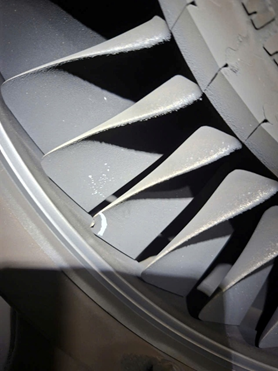
Nhìn ảnh trên là cánh turbine ABB TCA-55 đã mẻ và có dấu hiệu ăn mòn
Nhận xét.
1. Mẻ cánh rõ nét, vết mẻ trắng to ở mép đuôi cánh. Đây là Inconel mới bị lộ ra. Kích thước tầm 2-3 mm. Với TCA55 chạy 20,000-30,000rpm thì mẻ này là rất nguy hiểm
2. Ăn mòn nhiệt - Hot Corrosion. Toàn bộ mép trước của các cánh bị "sần sùi + ánh kim" như bị cát phun. Đây là đặc trưng của đốt dầu FO có Vanadium + Natri. Xỉ V2O5 nó ăn mòn Inconel ở 550-650°C.
Kết luận nguyên nhân: Đây không phải vật thể lạ đập 1 phát. Đây là Ăn mòn + Mỏi nhiệt + Rung gộp lại. Cánh bị ăn mòn mỏng đi → yếu → 1 cục muội than nhỏ bay vào là mẻ ngay.
Xử lý theo Manual Mitsui TCA55:
>>>>> Mức độ hư hỏng Hướng xử lý
Mẻ < 3mm, 1 cánh >> Mài bo tròn + Cân bằng động tại xưởng
Mẻ > 3mm hoặc >1 cánh>>Bắt buộc thay Rotor Turbine mới
*** 3 việc phải làm ngay:
1> Dừng máy / Không tăng tốc: Rung sẽ phá bearing rất nhanh
2> Kiểm tra lọc FO + nhiệt độ xả*: Chắc chắn có xi lanh cháy muộn. Nhiệt độ xả đang >620°C
3> Wash turbine. Nếu đốt FO thì phải tăng tần suất wash lên 250h/lần và kiểm tra phụ gia khử Vanadium.
You might be interested

Protective Shields on Main Engines – Purpose and Differences in Installation
Protective Shields are additional safety devices fitted around the cylinder ends of some MAN B&W ME engines, particularly at Cylinder No. 1 and No. 6. Although they are not standard factory equipment, many shipowners require their installation to protect crew members from high-temperature combustion gases that may escape under abnormal cylinder pressure, especially during main engine starting. The article explains the reason for their installation and why the arrangement may differ between engines of the same type.
See more
Sunrise Manpower Co., Ltd Conducts Marine Engineering Technical Training to Enhance Engine Officers' Professional Competence
As part of its ongoing commitment to developing competent and safety-conscious marine engineers, Sunrise Manpower Co., Ltd successfully conducted a Marine Engineering Technical Training Program for engine officers. The training combined technical knowledge, practical maintenance exercises, and operational experience sharing to strengthen participants' engineering competence and promote safe and efficient engine room operations.
See more
Bridge Experience Sharing: Guide to export ENC updates to ECDIS
This guide provides a step-by-step procedure for exporting ENC updates from OneOcean and importing them into the JRC JAN-9201 ECDIS, including the preparation of the USB device, export of ENC update data, installation of the exchange set and verification of the ENC update status. The procedure aims to ensure that the vessel’s Master and Back-up ECDIS are properly and accurately updated with the latest ENC information, supporting safe navigation and effective chart management.
See more
Night Order Book – The Master's Essential Guide for Safe Bridge Watchkeeping
The Night Order Book, also known as the Bridge Order Book, is one of the Master's most important navigational documents for ensuring safe bridge watchkeeping during nighttime operations. Although not explicitly required by the SOLAS Convention, it is developed in accordance with the STCW Code, ISM Code, and the vessel's Safety Management System (SMS). This article explains the regulatory basis, key contents, and practical implementation of the Night Order Book, highlighting its vital role in promoting effective communication between the Master and the Officer of the Watch, enhancing navigational safety, and ensuring compliance with international maritime standards.
See more
Master's Standing Orders: Essential Guidance for Safe Navigation and Bridge Watchkeeping
Master's Standing Orders provide clear instructions for bridge officers to maintain safe navigation when the Master is not on the bridge. This article summarizes the key principles, watchkeeping responsibilities, and critical situations in which the Officer of the Watch must immediately notify the Master.
See more


 CONTACT FOR CONSULTATION


